

Reading time: 12 minutes
Sometimes, your body begins to change long before you can find the words to describe what’s happening.
Maybe you’ve noticed little things that don’t seem connected. You wake up tired even after a full night’s sleep. Your patience isn’t quite the same. You lose your train of thought in the middle of a sentence. Your emotions feel closer to the surface than they used to.
If any of this sounds familiar, you’re not alone.
This guide was created to help you understand what happens during perimenopause, recognize its early signs, and learn practical ways to care for yourself with confidence and peace of mind.
Have you been feeling… different lately?
Do you wake up exhausted even after sleeping through the night?
Have you noticed that your patience seems a little shorter than it used to be?
Do you sometimes struggle to remember a word that used to come effortlessly?
Are your emotions feeling stronger—or simply different?
Have your favorite jeans suddenly become a little tighter, even though your eating habits haven’t really changed?
And your period…
Well, it seems to have developed a mind of its own.
At first, it’s easy to blame stress.
A busy schedule.
Work.
Family responsibilities.
Or simply getting older.
Then, almost without realizing it, one quiet question begins to linger in the back of your mind.
“What’s happening to my body?”
If you’ve been asking yourself that question, take a deep breath.
You are far from alone.
Millions of women begin noticing physical, emotional, and mental changes years before menopause officially begins.
What surprises many women is that these changes often seem unrelated.
Because they happen gradually, it’s easy to assume they’re caused by stress, burnout, or the natural demands of midlife.
Only later do many women discover that these symptoms may all be part of the same transition.
And once they understand what’s happening, something begins to change.
Confusion gives way to clarity.
Worry is replaced by understanding.
And understanding makes room for confidence.
That’s the journey we’ll take together.
What You’ll Learn in This Guide
By the end of this article, you’ll understand:
- What perimenopause really is.
- The early symptoms many women don’t recognize.
- Why your hormones begin to fluctuate.
- How these changes can affect your sleep, mood, memory, metabolism, and overall well-being.
- Everyday habits that may help you feel your best during this transition.
- When it’s time to talk with your healthcare provider.

This guide isn’t here to frighten you.
It’s here to help you understand your body so you can move through this stage of life with more knowledge, confidence, and self-compassion.
A New Chapter—Not the End of One
One of the biggest misconceptions about menopause is that it begins overnight.
It doesn’t.
Long before your periods stop completely, your body quietly begins a natural transition known as perimenopause.
For some women, the first sign is an irregular menstrual cycle.
For others, it’s restless nights.
Mood changes.
Unexpected anxiety.
Difficulty concentrating.
Or simply the feeling that something has changed—even if they can’t quite explain what.
Because these symptoms usually appear gradually, many women assume they’re simply dealing with stress, a demanding lifestyle, or the normal effects of aging.
In reality, changing hormone levels may already be playing an important role.
Understanding perimenopause won’t make every symptom disappear.
But it does something just as valuable.
It replaces uncertainty with understanding.
And once you understand what’s happening inside your body, you can make informed decisions about your health with far greater confidence.
Knowledge doesn’t remove every challenge.
But it changes the way we face them.
From Glaucia’s Heart
Over the years, I’ve noticed the same pattern again and again in conversations with women.
Many arrive convinced that something is wrong with them.
Some believe they’re simply overwhelmed by stress.
Others blame themselves for not having the same energy they had a few years ago.
Many quietly wonder if they’re somehow “failing” at getting older.
What they usually need isn’t criticism.
They need information.
When we understand that our bodies are going through a completely natural hormonal transition, we stop seeing every symptom as a personal failure.
Instead, we begin treating ourselves with more kindness.
More curiosity.
And greater respect for what our bodies are trying to tell us.
That shift in perspective can change everything.

Why Is Perimenopause Finally Getting the Attention It Deserves?
For many years, conversations about women’s health focused almost entirely on menopause itself.
Today, researchers and healthcare professionals recognize that the years leading up to menopause deserve just as much attention.
This is often the stage when women first begin experiencing changes that affect their quality of life.
Sleep.
Mood.
Energy.
Memory.
Metabolism.
Heart health.
Bone health.
All of these systems can be influenced by hormonal fluctuations during perimenopause.
Learning about this transition isn’t about expecting problems.
It’s about understanding that many common symptoms have a biological explanation.
And perhaps most importantly…
It’s about realizing that you are not alone.
Today, women have access to more research, better medical guidance, and evidence-based strategies than ever before to help them navigate this stage of life with confidence.
A Moment Just for You
Before we continue, take a moment to check in with yourself.
Have you noticed any of these changes over the past few months?
☐ Irregular periods
☐ Poor or interrupted sleep
☐ Mood swings or increased irritability
☐ Brain fog or forgetfulness
☐ Constant fatigue
☐ Hot flashes or sudden warmth
☐ Weight gain, especially around your midsection
☐ A lower sex drive
If you mentally checked off two or more of these, it doesn’t necessarily mean you’re in perimenopause.
But it may be a good time to pay closer attention to your body and discuss any concerns with your healthcare provider.
In the next sections, we’ll explore why these changes happen and how they may all be connected.
So… What Exactly Is Perimenopause?
Many women believe menopause begins the day their periods stop.
In reality, that’s simply the final milestone of a much longer journey.
The years leading up to menopause are known as perimenopause.
This is a natural stage of life during which the ovaries gradually begin producing less estrogen and progesterone.
Unlike what many people imagine, these hormones don’t decline in a straight line.
They fluctuate.
Some months, estrogen levels may be relatively high.
The next month, they may drop unexpectedly.
These hormonal shifts explain why symptoms often come and go without warning.
And they’re one of the main reasons so many women wonder whether something is wrong with them.
Most of the time, nothing is wrong.
Your body is simply beginning a new chapter.
When Does Perimenopause Usually Begin?
One of the questions women ask most often is:
“Am I too young to be in perimenopause?”
The answer often comes as a surprise.
For most women, perimenopause begins sometime between their 40s and early 50s.
However, it’s not unusual for hormonal changes to start as early as the late 30s.
Every woman’s body follows its own timeline.
The age at which perimenopause begins can be influenced by genetics, overall health, lifestyle, certain medical conditions, and whether the ovaries have been affected by surgery or medical treatments.
There’s also no universal timeline for how long this transition lasts.
For some women, it’s only a few years.
For others, it can continue for nearly a decade.
Most women experience perimenopause for four to eight years before reaching menopause.
During that time, symptoms often come and go.
Some months you may feel completely like yourself again.
Your energy returns.
You sleep better.
Your mood feels more balanced.
Then, seemingly out of nowhere, the symptoms return.
This unpredictability is one of the reasons perimenopause can feel so confusing.
Many women begin to question themselves.
“Maybe I’m just stressed.”
“Maybe I’m imagining it.”
“Maybe this is just part of getting older.”
In reality, those ups and downs often reflect the natural fluctuations of your hormones.

A Gentle Reminder
If some days you feel wonderful and others feel completely different, you’re not doing anything wrong.
Your body isn’t “broken.”
It’s adapting.
And like any major transition, adaptation doesn’t always happen in a straight line.
Approaching these changes with curiosity instead of fear can make this stage of life feel much less overwhelming.
Why Do Hormones Begin to Change?
To understand perimenopause, it helps to understand the incredible work your hormones have been doing for decades.
Throughout your reproductive years, your brain and ovaries communicate through an intricate hormonal feedback system.
Every month, your brain sends signals.
Your ovaries respond by producing hormones—primarily estrogen and progesterone.
These hormones do far more than regulate your menstrual cycle.
They help support:
- Ovulation and fertility
- Bone strength
- Heart health
- Brain function
- Metabolism
- Skin health
- Emotional well-being
- Sleep quality
- And many other essential processes throughout the body
As menopause approaches, the ovaries gradually become less responsive to those hormonal signals.
Ovulation becomes less predictable.
As a result, hormone production becomes less predictable too.
It’s important to understand that estrogen doesn’t simply decline overnight.
Instead, hormone levels often fluctuate dramatically.
Estrogen may be relatively high one month and significantly lower the next.
Progesterone usually begins declining earlier because its production depends on regular ovulation.
These hormonal shifts help explain why you may feel perfectly fine for weeks—only to notice changes in your sleep, mood, or energy seemingly overnight.
Estrogen Does Much More Than You Might Think
When most people hear the word estrogen, they immediately think about reproduction.
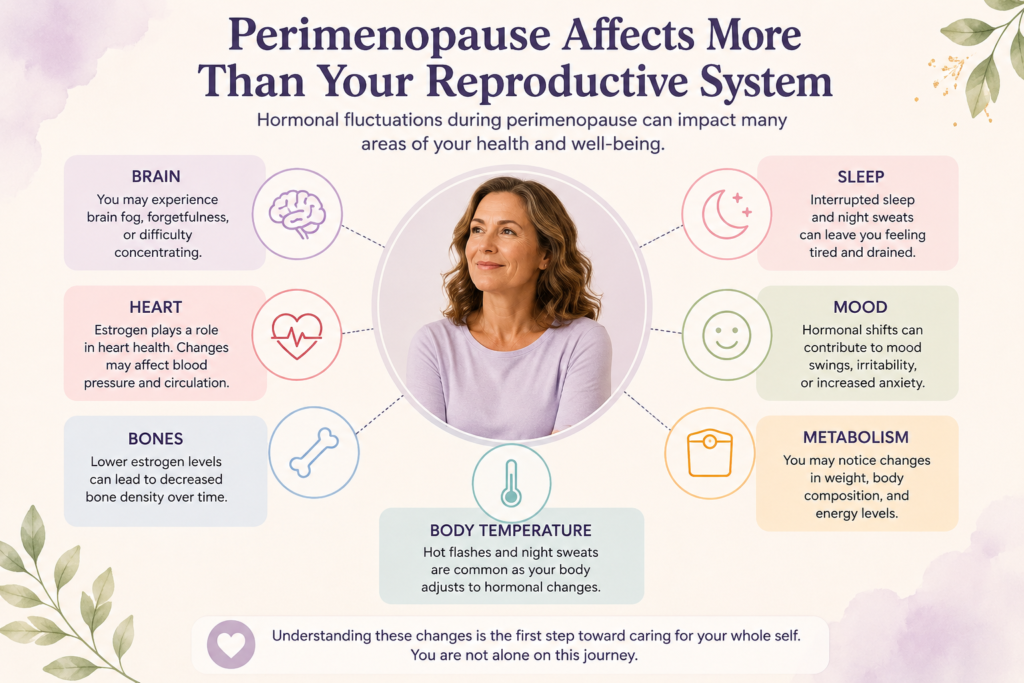
But estrogen plays a role in nearly every major system in the body.
It supports healthy brain function.
It helps maintain bone density.
It contributes to cardiovascular health.
It influences sleep quality.
It helps regulate body temperature.
It even affects memory, concentration, and emotional balance.
That’s why fluctuating estrogen levels can create changes that seem completely unrelated at first.
The symptoms may appear to come from different parts of the body.
In reality, they’re often connected by the same underlying hormonal transition.
Understanding that connection is one of the first steps toward feeling less anxious—and much more empowered.
The Often-Overlooked Role of Progesterone
Progesterone doesn’t receive nearly as much attention as estrogen, but it’s equally important.
Beyond preparing the uterus for pregnancy, progesterone has a calming effect on the nervous system.
As ovulation becomes less frequent, progesterone levels naturally begin to decline.
Some women notice more restless sleep.
Others experience increased anxiety or heightened emotional sensitivity.
Some simply find it harder to relax.
Of course, hormones aren’t responsible for every emotion we experience.
Life continues to bring its own challenges, responsibilities, and stresses.
But recognizing that biology also plays a role allows us to approach ourselves with much more compassion.
Does This Sound Familiar?
Maybe you’ve experienced something like this.
One week, everything feels normal.
The next, a small inconvenience suddenly feels overwhelming.
Perhaps you’ve found yourself becoming emotional over something that normally wouldn’t affect you.
Or maybe you feel frustrated because you don’t quite recognize yourself.
If that sounds familiar, you’re not alone.
These emotional shifts don’t mean you’re weak.
They don’t mean you’re losing control.
Often, they’re simply one way your brain responds to changing hormone levels.
Understanding that doesn’t erase the emotions.
But it can replace self-criticism with self-understanding.
And that’s an important difference.
The Science Behind Hormonal Fluctuations
Imagine standing by the ocean.
Some days, the water is calm.
The waves are gentle.
Everything feels steady.
Other days, the tide changes.
The waves grow stronger.
The sea becomes unpredictable.
Hormones during perimenopause behave much the same way.
They rarely follow a smooth, predictable path.
Instead, they rise…
Fall…
And shift from month to month.
That’s why you may sleep beautifully one week and struggle the next.
Why your energy feels abundant one day and noticeably lower a few days later.
Why your emotions sometimes feel completely in balance—and at other times, unexpectedly intense.
None of these experiences mean you’re “losing yourself.”
They’re simply signs that your body is adjusting to a new hormonal landscape.
Why Do So Many Symptoms Seem Unrelated?
One of the most confusing aspects of perimenopause is that the symptoms often appear disconnected.
You may notice:
- Poor sleep
- Mood changes
- Brain fog
- Forgetfulness
- Hot flashes
- Joint discomfort
- Weight gain, particularly around the abdomen
- A lower sex drive
- Increased emotional sensitivity
At first glance, these seem like completely separate issues.
In reality, many of them can share the same underlying cause: fluctuating hormone levels.
Once you begin to see the bigger picture, those seemingly unrelated symptoms start making much more sense.
Instead of viewing each change as an isolated problem, you can understand them as different expressions of the same natural transition.
And that shift in perspective often brings something incredibly valuable:
Peace of mind.
Why Every Woman’s Experience Is Different
If you’ve talked with friends about perimenopause, you’ve probably noticed something interesting.
No two stories are exactly alike.
One woman may experience frequent hot flashes.
Another may never have one.
Some notice emotional changes long before their periods become irregular.
Others experience changes in their menstrual cycle for years before any other symptoms appear.
And that’s completely normal.
Perimenopause isn’t a one-size-fits-all experience.
Your genetics matter.
Your lifestyle matters.
Your sleep.
Your nutrition.
Your stress levels.
Your overall health.
Even certain medications can influence how your symptoms develop.
That’s why comparing yourself to someone else’s journey rarely brings comfort.
More often, it creates unnecessary worry.
Your body has its own timeline.
Its own biology.
Its own way of adapting to change.
The goal isn’t to have the “right” perimenopause experience.
The goal is learning to understand your own.
Because when you stop comparing and start listening to your body, everything begins to feel a little less overwhelming.
Supporting Your Body Through This Transition
While perimenopause is a natural part of aging, there are many ways to support your body during this stage of life.
The good news?
You don’t need to change everything overnight.
In fact, small, consistent habits often make the biggest difference.
Prioritize Restorative Sleep
Quality sleep becomes even more important during perimenopause.
Creating a relaxing bedtime routine, limiting screen time before bed, and maintaining a consistent sleep schedule may help improve both sleep quality and overall well-being.
Some nights will still be challenging.
That’s okay.
Progress matters more than perfection.
Nourish Your Body
There’s no single food that can “cure” perimenopause.
But nourishing your body with whole, nutrient-dense foods gives it the support it needs during this hormonal transition.
Aim for plenty of vegetables, fruits, lean proteins, healthy fats, legumes, and fiber-rich foods.
You may also notice that alcohol, excessive caffeine, highly processed foods, or added sugars make certain symptoms—such as hot flashes or poor sleep—more noticeable.
Instead of focusing on restrictive diets, think about giving your body the nutrients it needs to thrive.
Keep Moving
You don’t have to become a marathon runner.
Or spend hours at the gym.
Walking.
Strength training.
Yoga.
Pilates.
Swimming.
Dancing.
Choose the movement you genuinely enjoy.
Regular physical activity supports heart health, bone strength, mood, sleep, and metabolism.
The best exercise isn’t the most intense one.
It’s the one you’ll actually continue doing.
Care for Your Emotional Well-Being
Hormonal changes can make emotions feel stronger.
But your emotions are not your identity.
If you’ve been feeling more anxious, emotional, or overwhelmed lately, try offering yourself the same kindness you would offer a close friend.
Talk to someone you trust.
Practice mindfulness.
Spend time outdoors.
Seek professional support if your symptoms begin affecting your quality of life.
Asking for help isn’t a sign of weakness.
It’s an act of self-care.
Stay Up to Date with Preventive Care
Perimenopause is an excellent time to become even more proactive about your health.
Regular checkups allow your healthcare provider to monitor changes, answer questions, and help you make informed decisions based on your personal health history.
Preventive care isn’t about looking for problems.
It’s about protecting your future health.
An Eastern Perspective: What Traditional Chinese Medicine Teaches Us
While Western medicine explains perimenopause primarily through hormonal changes, Traditional Chinese Medicine (TCM) views this stage through a broader lens of balance and energy.
According to TCM, shifts involving the Kidney, Liver, and Heart systems may contribute to symptoms such as insomnia, irritability, fatigue, and hot flashes.
Although these perspectives use different languages and concepts, they share an important principle.
Health is interconnected.
Sleep matters.
Nutrition matters.
Movement matters.
Stress management matters.
Self-care matters.
Many women find that combining evidence-based conventional medicine with complementary practices—under the guidance of qualified healthcare professionals—provides a more holistic approach to well-being.
The goal isn’t choosing one approach over another.
It’s finding the combination that best supports you.
When Should You Talk to Your Healthcare Provider?
Not every symptom is cause for concern.
But some deserve medical attention.
Schedule an appointment if you experience:
- Heavy or prolonged menstrual bleeding
- Bleeding after sexual intercourse
- Long periods without menstruation that haven’t been evaluated
- Symptoms that significantly affect your sleep or daily life
- Frequent or severe hot flashes
- Persistent anxiety, depression, or mood changes
- Any symptom that causes concern or feels unusual for you
Seeking medical advice doesn’t mean something is seriously wrong.
It simply means you’re taking good care of your health.
And that’s always worth doing.
Frequently Asked Questions
Can perimenopause start before age 40?
Yes.
Although it’s most common during the 40s, some women begin experiencing hormonal changes in their late 30s.
Does every woman experience hot flashes?
No.
Symptoms vary widely.
Some women never experience hot flashes, while others consider them one of their most noticeable symptoms.
Can I still get pregnant during perimenopause?
Yes.
As long as ovulation continues—even if it’s irregular—pregnancy is still possible.
If pregnancy isn’t part of your plans, talk with your healthcare provider about contraception.
How long does perimenopause last?
For most women, perimenopause lasts between four and eight years, although the timeline varies from person to person.
Can perimenopause cause anxiety?
Hormonal fluctuations can contribute to anxiety and mood changes.
However, emotional well-being is influenced by many factors, including life circumstances, stress, relationships, and overall health.
A Gentle Reminder as You Move Forward
Perimenopause isn’t the end of your vitality.
It isn’t the end of your femininity.
And it certainly isn’t the end of your story.
It’s simply the beginning of a new chapter.
One that invites you to understand your body in a deeper way.
To slow down when needed.
To listen more carefully.
To care for yourself with the same compassion you’ve likely offered everyone else throughout your life.
The more you understand what’s happening inside your body, the less room there is for fear.
And the more confidence you’ll have in making decisions that support your long-term health.
Remember this:
You don’t have to go through this alone.

Millions of women are walking this same path.
Today, we have more research.
More knowledge.
More compassionate healthcare professionals.
And more resources than ever before.
May this guide be the beginning of a healthier, more confident relationship with your body.
Because understanding your body is one of the greatest acts of self-care.
Let’s Keep the Conversation Going 💜
If this guide helped you better understand perimenopause, we’d love for you to stay connected.
Our goal is simple:
To provide trustworthy, evidence-based health information in a warm, approachable way—so you can make informed decisions with confidence at every stage of life.
If you know another woman who may be navigating this transition, consider sharing this article with her.
Sometimes, the right information arrives exactly when someone needs it most.
Our Commitment to You
Every article published on this blog is created with one purpose:
To inform, support, and empower—not to create fear.
Our content is based on the best scientific evidence available at the time of publication and written in language that’s clear, compassionate, and easy to understand.
Because every woman is unique, the information shared here should never replace personalized medical advice from a qualified healthcare professional.
Instead, we hope it helps you ask better questions, feel more confident, and become an active partner in your own health journey.
With care,
Glaucia
“Understanding your body is the first step toward caring for it with confidence and compassion.”